Posts

Showing posts with the label Sheridan Le Fanu

Happy Birthday, Ingrid Pitt! Hammer Time and an Amicus Brief

Image
Countess Dracula (1971) was the film that introduced me to Elizabet Bathory. I remember being disappointed as young teen that there was no Dracula to be found, but that disappointment changed when I laid eyes on Ingrid Pitt (and Nike Arrighi and Lesley-Anne Down). I also remember the “Hammer atmosphere” and its subtle web of a kind of dreaminess that both undermined and underscored the horrors in the film. The first Hammer film I saw was a rerelease of The Horror of Dracula somewhere around 1966 or 1967. There were heaving bosoms, a riveting Count Dracula who said nothing because he didn’t need to, and his demise at the end that left me speechless. It would be a few years and then I’d catch Hammer’s The Curse of Frankenstein , The Mummy , Count Dracula , and The Brides of Dracula .  Hammer films were fascinating in a different way from Universal’s horror films. They were sexier, sure, but it was the pacing, the acting, and that general state of some kind of dream logic at work, e...
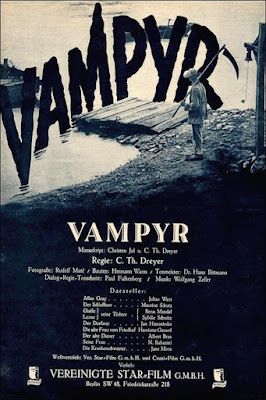
Vampires: still in season! Dreyer’s “Vampyr” and Portabella’s “Vampir”

Image
As the day draws closer, I really am increasingly inspired to watch as much “horror” as I can. Following my inclinations, I am bouncing across eras and the past couple of days, I decided to head back to 1932. Carl Theodore Dreyer’s “Vampyr” was shot over a longish period the previous year with Dreyer’s aim to make a film unlike any other. He succeeded admirably. Unfortunately, contemporary audiences and critics were not just unkind, they were antipathetic toward the enterprise so much that it was considered a minor work and best forgotten. Fortunately, it is now recognized as a work that transcends the genre and is now very much remembered. I’ve seen it three or four times and each time, it grows deeper for me, particularly as an example of oneiric cinema. It is often lumped in as a piece of expressionism, and a case could be made for it; but not the German expressionism of, say, Wedekind or Pabst, much less the proto-Expressionsim of Murnau. But Dreyer shares a sense of the dreamli...