Posts

Showing posts with the label Alfred Hitchcock

30s Hitch: Hitchcock’s Theories of Music in Film and Waltzes from Vienna (1934)

Image
This was a pleasant surprise that I was dreading. I have actively avoided watching Waltzes from Vienna because Hitchcock himself was so dismissive of it later in life(1) and pretty much hated the filming process. However, it turns out to be a fairly light entertainment and in terms of Hitchcock’s evolution, more significant than he would let on later in his life.  Despite Hitchcock’s later dismissal of the film, it proved to be a pivotal work for him, at least in regards to the use of music in film. I’m going to quote extensively from an interview conducted in Cinema Quarterly, Winter 1933-1934 with Stephen Watts for two reasons. The first is to demonstrate that this film did have more importance to Hitch than he let on later (even if it might be for purely formal purposes) and also because his remarks on music in film are in themselves worth looking at for what music meant to Hitchcock specifically, but also, its place in early sound film history . Hitchcock’s reflections on t...
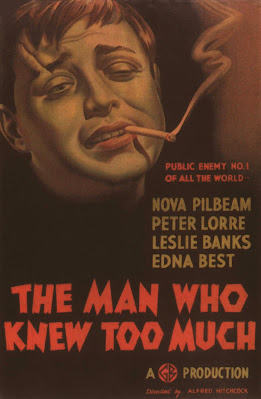
30s Hitch: The Man Who Knew Too Much (1934)

Image
The move to Gaumont British Picture Corporation (just “Gaumont” from here on) afforded Hitchcock a larger, more sophisticated canvas and the first movie was a righting of wrongs and a genuine “told you to so” to one producer specifically. More than that, though, The Man Who Knew Too Much is a template and manifesto of the films to come. In its brisk run-time, it seeds the screen with a number of themes that Hitchcock would explore in greater depth with increasing assurance over the coming decades. It’s a delicious little film that practically demands you watch it again. I use the word “economy” a fair amount. A 75 minute show can feel stuffed to the gills with wit and profundity and be over before you know it. Or it can drag on ridiculously to the point of taxed patience or sleep. A three hour epic can fly by, and so on. Here, Hitch has brought us an instruction manual of how you direct a fleet, witty, and even provocative film in under an hour and a half, handily. Edna Best and Lesli...

30s Hitch: The Thriller Sextet

Image
Having completed and suffered the twin humiliations of Waltzes from Vienna and the critical and box-office failure of Rich and Strange , Hitchcock found a new lease on life out from under the foundering British International Pictures. What happened next wasn’t just a restoration of his reputation but a leap forward into the Hitchcock that would find his full flowering in Hollywood with newer technology, larger budgets, and a broader stable of actors to choose from.  If I’ve devoted more time to the pre-Thriller Sextet (Donald Spoto’s coinage), it’s to point up the contrast of what a Hitchcock following his instincts in a more challenging genre would look like against one that was under contract and had to work in a proscribed environment. We’ve seen what happens when a director gives up, cedes power and/or hope, or just capitulates to the demands of producers or the masses.  At the same time, we’ve seen how Hitchcock could employ his ample and sure talent to - in contemporary...